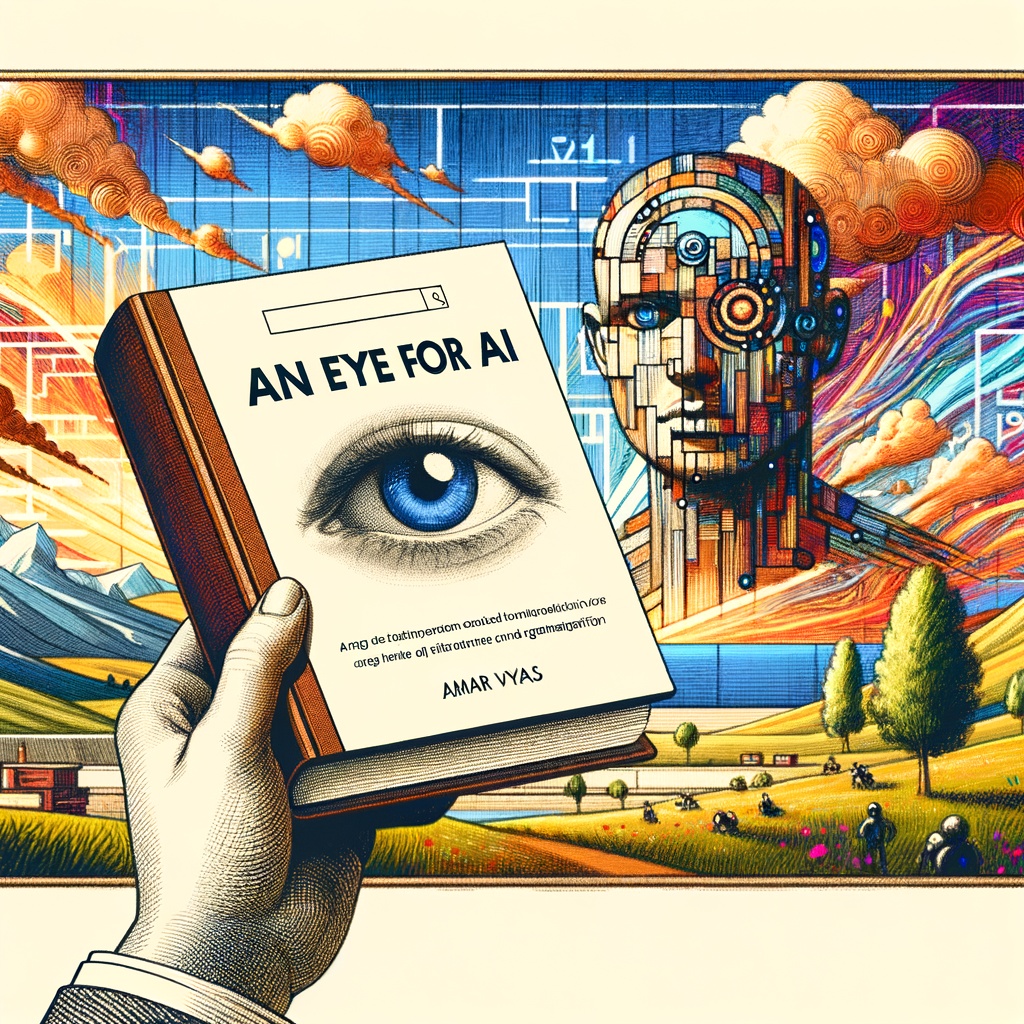
An Eye for AI Book by Amar Vyas, provides an excellent resource for anyone looking to learn more about the rapidly evolving field of AI Imaging technology. In this book, Vyas provides a comprehensive overview of AI, from its inception to its current state, and the potential it holds for the future.
About An Eye for AI Book
The book byAmar Vyasis written in a clear, concise, and accessible manner, making it suitable for both technical and non-technical readers. Vyas covers a range of topics, including the history of AI, its current applications, and the ethical and societal implications of its use.
Artificial Intelligence (AI) has become one of the most significant technological advancements in recent years. It has the potential to revolutionize industries and change the way we live our lives. However, as with any new technology, there are many misconceptions and misunderstandings about it. That’s why it’s essential to have a clear understanding of AI and its implications.
One of the key aspects of this book is its emphasis on practical, hands-on learning. Throughout the book, we’ll be using some of the most popular tools for AI image generation, including NightCafe, DALL-E 3,LeonardoAI,StarryAI, MagicStudio, and Adobe Firefly. Each of these tools brings its own unique capabilities and features to the table, and we’ll be diving into each one in detail.
Whether you’re looking to create stunning digital art, enhance the quality of your photos, or generate 3D models, these tools will be your companions on this journey. Through practical projects and real-world examples, you’ll learn how to leverage the power of AI to create visually stunning and unique images.
By the end of this book, you’ll not only have a solid understanding of AI and its role in image generation, but you’ll also be equipped with the practical skills and knowledge needed to use AI in your own creative endeavors. Whether you’re an artist, a designer, a hobbyist, or just someone with a keen interest in the possibilities of AI, this book will open your eyes to the incredible potential of AI in image generation.
To learn more, visit www.artwithai.in
Excerpt
The chapter “Creating Digital Art,” from An eye for AI book shows you how to use AI to make your own amazing digital art. It doesn’t matter if you’re a seasoned artist or a newbie who is curious about how tech can blend with art, this section is made just for you!
We’ll start with the basics of AI and how it can be used to create pictures. Then, we’ll show you some real examples of how to use these ideas to make your own digital art. You can make anything from simple doodles to detailed landscapes with AI – the sky’s the limit! By the end of this section, you’ll know how to use AI to add a special touch to your digital art, letting you make things you may have never thought possible before.

Sample Table of Contents
Chapter 3: Getting Started with AI Image Generation 3.1 Required Tools and Software 3.2 Setting Up the Environment
Chapter 4: Exploring AI Algorithms for Image Generation 4.1 GANs (Generative Adversarial Networks) 4.2 Autoencoders 4.3 Transformer Models
Chapter 5: Practical Projects with AI Image Generation 5.1 Project 1: Creating Digital Art 5.2 Project 2: Enhancing Photo Quality 5.3 Project 3: Generating 3D Models
Chapter 6: Evaluating and Testing AI Generated Images 6.1 Importance of Testing and Evaluation 6.2 Techniques for Evaluating AI Generated Images
Chapter 7: Ethical Considerations and Challenges in AI Image Generation 7.1 Ethical Concerns 7.2 Overcoming Challenges
Chapter 8: The Future of AI in Image Generation 8.1 Emerging Trends 8.2 Preparing for the Future
My abandoned plan to reate a website for this book
The idea for a micro-site for "An Eye for AI began in late November 2022 as a way to share progress on the book with a small circle. Initially hosted on Brick.do, a Notion-like CMS, the site had a rudimentary layout. However, it gained unexpected traction when friends shared it with their networks. Feedback on UI, structure, and mobile readability forced a pivot: I spent a weekend in mid-December 2022 refining the design. The core challenge was that 2,000-word chapters were unwieldy for single-page reading, especially on mobile. This required splitting content into smaller sections, which Brick.do couldn’t elegantly support. The site owner also changed their Content Delivery Network (CMS) at the back end, adding more reason to abandon this CMS altogether.
The search for a self-hosted, markdown-friendly CMS led me to explore HTMLy, Bludit, and Typemill. While HTMLy and Bludit were familiar from past projects, they were better suited for blogs than structured book content. Typemill stood out for its lightweight design and book-centric features. I tested multiple themes—Cyanine, chosen for its simplicity, and Knowledgebase, rejected for poor mobile formatting—and customized Cyanine’s colors for better readability. The final version, launched on New Year’s Eve 2022, used a browser-based workflow to test Typemill’s limits and my shared hosting’s capacity, paired with BunnyCDN, Cloudflare, and YouTube for performance.
By January 2023, I planned to switch to local editing via VSCodium and Abricotine for efficiency. However, the experiment revealed a deeper truth: Typemill’s learning curve and the time spent tweaking themes delayed the book’s progress. The site became a distraction from writing, and while the technical setup was sound, the opportunity cost—days lost to CMS trials instead of content—ultimately led me to discontinue the approach. The project highlighted a tension between my desire for raw markdown control and the practical need to prioritize writing over tooling.