
I had a problem. Over the years, my hosting setup had grown into a tangled mess. What started as a single VPS for a personal project had ballooned into a sprawling collection of servers, domains, and subdomains scattered across multiple locations. I was the only one managing it all, and it was getting harder to keep track of what was where, what was necessary, and what was just sitting there unused.
The Lay of the Land
At its worst, I had VPS instances in Singapore, Atlanta, the Netherlands, New York, NJ USA, Mumbai, and Bengaluru. Some were actively hosting projects I cared about, like gaathastory.com. Others were experiments I’d forgotten about or servers I’d spun up for temporary needs and never shut down. Storage was just as chaotic—backup solutions, test environments, and leftover services from old projects. Shared hosting accounts for smaller sites like gaatha.me and gstr.in added to the complexity.
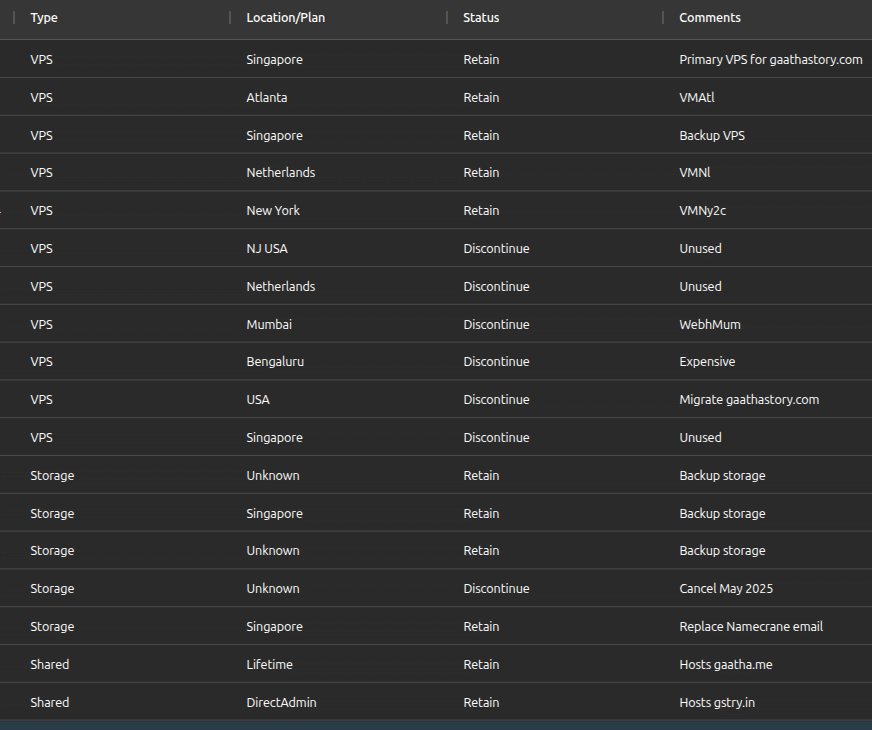
I didn’t realize how bad it had gotten until I sat down and listed everything out. The table below was my first attempt at making sense of it all.
Looking at it all in one place was a wake-up call. I was paying for servers I wasn’t using, storage I didn’t need, and domains that were just collecting dust. Worse, the mental load of managing it all was starting to weigh on me. I knew I had to do something
The Plan
I decided to treat it like surgery—cut out the dead weight, reorganize what was left, and make sure everything that remained had a clear purpose. My goals were simple:
- Retire the unused: Shut down VPS instances and storage that weren’t doing anything.
- Consolidate: Move services to fewer, more strategic locations.
- Simplify: Reduce the number of domains and subdomains to only what I actually needed.
- Document: Keep better records so I wouldn’t end up in the same mess again.
I started by identifying what was essential. gaathastory.com was a priority, so I kept its VPS in Singapore. Other projects, like gaatha.me and gstr.in, were hosted on shared services that were working fine, so I left them alone. The rest—I marked for review.
For the domains and subdomains, I drew a simple diagram to visualize the structure. It helped me see which parts were necessary and which could go.
Implementation
I started with the low-hanging fruit: the unused VPS instances. I shut down the ones in NJ USA, Mumbai, and Bengaluru. They weren’t hosting anything critical, and keeping them running was just a waste of money. Next, I tackled storage. I canceled redundant backup solutions and consolidated what was left into a single, reliable setup.
The trickier part was migrating gaathastory.com from its VPS in the USA to the one in Singapore. I wanted to reduce latency for my Asian audience, and it made sense to host it closer to them. I used Caddy for the web server, and my own caddyscript tool to automate the configuration. It wasn’t perfect—I hit a few snags with DNS propagation and had to troubleshoot some redirects—but I got it working in the end.
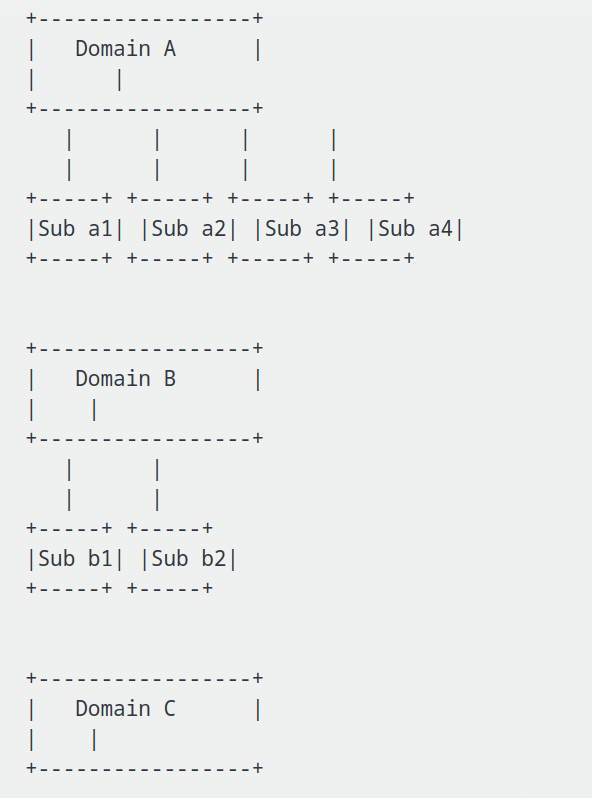
For the domains and subdomains, I merged or retired the ones that weren’t necessary. Domain A, with its four subdomains, was a good candidate for consolidation. I kept the ones I needed and let go of the rest. It felt good to simplify.
Timeline
I didn’t do it all at once. I spread the work over a few weeks to avoid breaking anything important.
- Week 1: Audited everything. Listed out all VPS instances, domains, subdomains, and storage. Identified what was essential and what wasn’t.
- Week 2: Shut down the unused VPS instances and canceled redundant storage. Started migrating gaathastory.com to the Singapore VPS.
- Week 3: Finished the migration, updated DNS records, and reconfigured Caddy. Tested everything to make sure it was working.
- Week 4: Reviewed the changes, documented the new setup, and made sure I wasn’t missing anything.
What I Learned
The biggest lesson was that small decisions add up. Every time I spun up a new VPS or registered a new domain without a clear plan, I was adding to the chaos. Now, I ask myself: Do I really need this? before I create anything new. I also learned the value of documentation. If I had kept better records from the start, I would’ve saved myself a lot of time and headaches. Now, I document every change, no matter how small. Finally, I realized that automation is worth the effor*. Tools like caddyscript saved me hours of manual work. If you’re managing multiple sites or servers, investing time in automation will pay off.
Where I Am Now
My hosting setup is still a work in progress, but it’s a lot cleaner than it was. I’ve cut costs, reduced complexity, and made it easier to manage. Most importantly, I feel like I’m back in control.