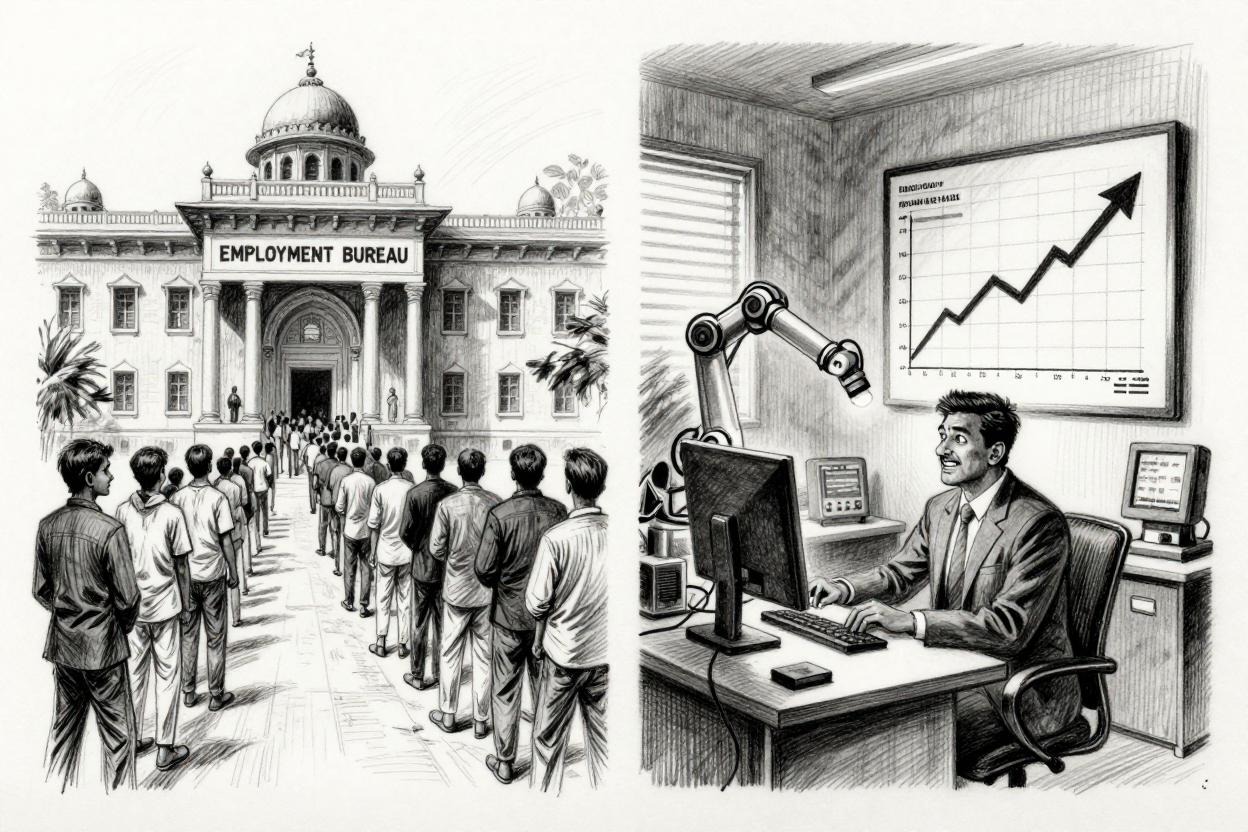
Every major technology and operational shift over the past 35 years has faced atypical 7-to-10-year maturity curve. Technology itself is rarely the true bottleneck; institutional inertia and legacy human workflows are. From the ERP rollouts in the US in the 1990s to Cloud Migration in the 2010s, to the "AI mania" of 2020s...the pattern is quite similar. Below is the sequence of timeline:
The 10-Year Technology Adoption Curve
Years 0–3 (Hype & FOMO)
Years 3–5 (Friction & FUD) (Current AI Phase)
Years 5–7 (Process Redesign)
Years 7–10 (Stabilization & ROI)*
The current wave of Fear, Uncertainty, and Doubt (FUD) regarding enterprise AI marks a predictable transition from raw hype to financial discipline. Human institutions simply cannot absorb raw technological power without undergoing a structural restructuring of their workflows.
Enterprise AI Is In The Friction Phase
Recent negative headlines—including an unmanaged $500 million Claude token bill, a ridesharing firm depleting its annual AI budget in four months, and global fast-food giants rolling back automated supply chain tools—do not signal the bursting of an AI bubble. Instead, they represent the predictable Years 3–5 friction phase that every technology wave hits.
The Informational Eyeball Bias ensures media coverage favors catastrophic, high-dollar failures over gradual operational optimizations. A headline shouting somethling like
"Autonomous Agent Loops Cause Half-Billion Dollar Catastrophe" goes viral instantly,while
"Enterprise improves logistics margin by 6%" achieves zero public velocity.
This structural bias causes casual observers to mistake early integration friction for absolute systemic failure. Meanwhile, the Capital Expenditure Reality Check reveals that if the core enterprise utility of AI were genuinely dissolving, aggregate capital expenditure trends among hyperscalers and institutional buyers would collapse. Global infrastructure commitments remain at historic highs. What is concluding is unmonitored R&D spending. CFOs are revoking open-ended blank checks and shifting into traditional IT procurement with strict usage caps. This pattern played out identically with ERP systems in the late 1990s, cloud migration in the 2010s, and core banking automation in India during the early 2000s.
Three Historical Cases
India Core Banking Automation (Late 1990s – Mid 2000s)
Regulatory mandates from the Central Vigilance Commission pushed Public Sector Banks to automate core banking software to curb fraud. Legacy branch staff, accustomed to physical ledger books and manual tallies, resisted the interface models. Systems routinely glitched under peak transaction volumes, data migration pipelines corrupted, and massive queues spilled onto public streets. The media ran daily front-page stories warning computerized banking was an expensive failure.
The Process Re-engineering Pivot: Banks paused further deployment, launched massive nationwide internal training programs, completely altered physical branch layouts to accommodate terminal architectures, and standardized data entry hierarchies. Today, that re-engineered process underpins an ecosystem executing billions of real-time transactions smoothly.
US ERP Rollouts (Late 1990s – Early 2000s)
A Fortune 500 candy giant rushed an integrated ERP and logistics rollout, condensing a 48-month timeline into 30 months. Mid-level managers bypassed the software using legacy, informal supply chain habits. The system locked up, leaving millions of dollars of inventory untracked. The firm missed $100 million in holiday candy shipments, causing its stock to crater 35%. A multi-billion dollar pharmaceutical wholesaler faced similar fate—order processing capacity plummeted from 420,000 items nightly to just 10,000, driving the corporation into total bankruptcy.
The Process Transformation: These catastrophes forced the birth of Business Process Reengineering. Enterprises understood that technology cannot fix an unoptimized mess. To make software work, a corporation must completely rewrite its internal operating procedures to align with the software's underlying logic.
Cloud Migration Billing Shock (2010s)
Executive mandates directed companies to shut down physical data centers and migrate everything to AWS, Azure, or Google Cloud. Engineering teams were given unmonitored access to spin up virtual instances, leaving expensive servers running 24/7 without usage guardrails. Runaway multi-million dollar monthly bills hit boardrooms. The business press predicted a total wave of cloud re-shoring, labeling data centers an unsustainable tech scam.
The Process Transformation: The corporate world did not abandon cloud computing. Instead, they invented FinOps (Financial Operations)—bringing algorithmic fiscal accountability, rigid real-time spending caps, and automated resource-tagging to cloud development.
Implementation Comparison
| Era | The Shift | Friction (Years 3–5) | Resolution (Years 5–10) |
|---|---|---|---|
| India 1990s–2000s | Core Banking | Staff resistance, system glitches | Retraining, branch redesign |
| US 1990s | ERP Rollouts | Inventory lockups, missed orders | Business Process Reengineering |
| US 2010s | Cloud Migration | Runaway billing shocks | FinOps frameworks |
| Global 2023–2026 | Generative AI | Token billing shocks | AI Governance / Token FinOps |
Read The Full Analysis
For deeper case studies (UK healthcare centralization, Australian payroll automation failures), implementation timelines, source links, and multilingual summaries in Hindi and Marathi, read the complete analysis on my [author blog](https://amarvyas.in). This short version serves as a quick reference; the full article builds the evidentiary backbone behind each claim.References
-
The Hershey's ERP Failure (1999): Harvard Business School Case Study / Wall Street Journal Archive
-
The FoxMeyer Drug Bankruptcy (1996): Delphi Group Research / Computerworld Archive
-
The Toyota Production System & Lean Evolution (1970s–1980s): Womack, Jones, Roos - The Machine That Changed the World
-
The Birth of FinOps (2010s): FinOps Foundation / O'Reilly Media Cloud Cost Optimization
-
UK NHS National Programme (2011): British Medical Journal Report / UK National Audit Office
-
Queensland Health Payroll Failure (2010): Commission of Inquiry Report